AI and Ontology — High Value Added for BI Teams and Business Users
Business analysts spend their days navigating pre-built dashboards, waiting for new reports, or working around the limits of what was designed weeks or months ago. What if you could ask a question that no report was built to answer — and get a reliable, business-accurate response in seconds?
That is what AI and Ontology make possible inside the AI@CDS framework.
The Question No Dashboard Can Answer
Here is a real example of the kind of question that stops BI teams in their tracks:
"What is the share of non-inventory free-of-charge items in my sales report by region?"
This is not a simple filter on a standard report. Answering it correctly requires knowing what "free of charge" means in your SAP configuration, understanding whether an item triggers a stock movement, and being able to cross-reference those rules against sales data — by region.
Traditionally, a developer would need to extract and join multiple SAP tables, understand the SD customising logic, and build a dedicated measure. That takes days, not minutes.
With Ontology and AI, the answer is available on demand.
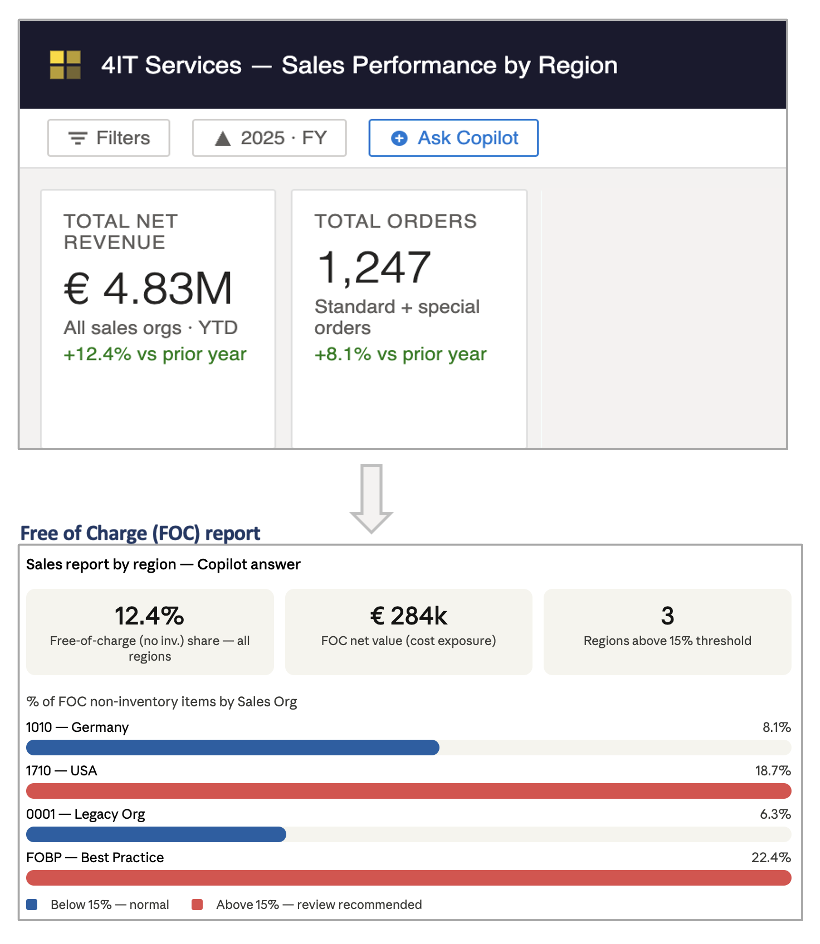
How AI@CDS Integrates with Ontology and SAP SPRO
The key to making this work is not just AI — it is grounding the AI in your actual SAP configuration.
AI@CDS extracts the business rules that live in your SAP backend — primarily from SPRO customising tables — and maps them into a Microsoft Fabric Ontology. This ontology does not just store data: it captures meaning.
For example:
-
Table TVAP defines item categories. If an item category like
TANNis configured as not billing-relevant, the ontology records this as the attributeBillingRelevance = NotBillable— or simplyFreeOfCharge = true.Note: TANN is used here as a standard SAP example. Item category configuration is always client-specific — your ontology will reflect your own SPRO setup.
-
Table TVEP defines schedule line keys, which determine whether an item triggers a stock movement (goods issue, return, or none). The ontology maps this to
InventoryRelevant = falsefor non-inventory items.
Once these mappings are in place, the Azure AI assistant can reason at the business concept level — not at the raw database field level.
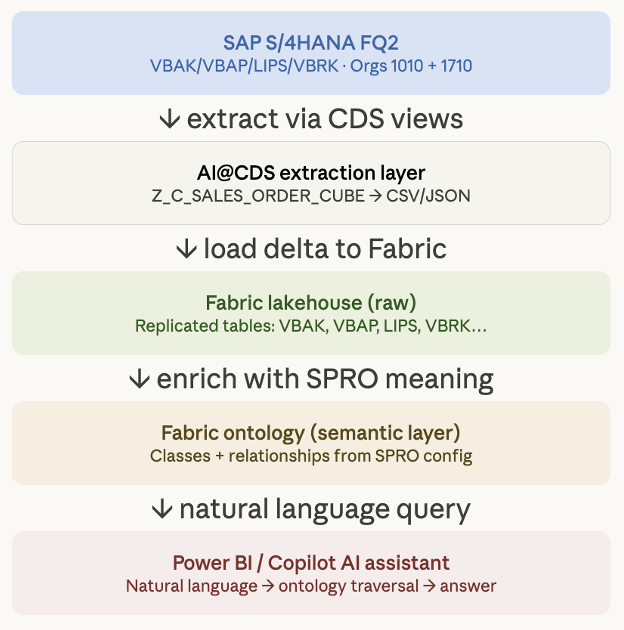
The extraction and ontology population is handled automatically by the 4IT AI Agents, which read the CDS views and SPRO configuration from S/4HANA and generate the semantic layer in Azure — including the bronze, silver, and gold pipeline — without manual mapping effort.
For a full walkthrough of how this works step by step, see the AI@CDS Ontology and AI documentation.
Beyond the data mapping, the ontology enables genuine functional reasoning. When a business user asks about free-of-charge items, the AI can resolve the question by combining the billing relevance rules from item category configuration with the stock movement rules from schedule line configuration — producing a semantically correct, business-level answer. The result can be delivered as a direct insight or as a DAX measure ready to use in a Power BI report.
Ontology is Part of the AI@CDS Framework
Ontology is not a standalone add-on — it is a core component of the 4IT AI@CDS framework, designed from the ground up to work alongside CDS extraction, data platform modelling, and the cloud application.
The entire flow is connected:
- CDS views and SPRO configuration are extracted from SAP S/4HANA
- AI Agents generate the semantic layers and populate the Microsoft Fabric Ontology
- The ontology enables the Azure AI assistant to reason about your business — answering ad hoc questions, generating DAX measures, and providing insights that no pre-built report could deliver
This is what makes AI@CDS different from a generic data integration tool: the intelligence is embedded in the data model, not bolted on top of it.
→ Explore the full Ontology and AI documentation
The Bigger Picture — High Value Added for the Business
The ultimate objective of the AI@CDS framework goes beyond technology. It is about fundamentally changing the role of the BI team.
Today, BI and DWH teams spend the majority of their time on extraction, transformation, modelling, and maintenance — leaving limited bandwidth for the work that actually matters to the business: insights, analysis, and decision support. Time-to-customer is too long. Business teams wait. Opportunities are missed.
With AI@CDS and Ontology, the technical pipeline becomes largely automated. BI teams are freed from routine maintenance and positioned to become champions for the Business — delivering high-value analytics and strategic intelligence that was simply not possible before. At the same time, business users gain direct, self-service access to ad hoc insights — without waiting for a developer to build a new report.
The existing team does not shrink — it grows in impact.